Hytale Gaia
In Hytale, Gaia is more than a character, she is the world. As the Avatar of Orbis, Gaia is the living embodiment of the planet players explore across all zones, and her presence shapes everything from elemental affinities to the sacred structures hidden across the land. Whether you encounter her as a crumbling ancient statue in the wilderness, feel her influence through the elements of Zone 1, or stand before the ruins of her temple for the first time – the legend called Hytale Gaia is the thread that connects Orbis to its deeper story.
Overview Hytale Gaia:
Hytale Gaia: Avatar of Orbis
In Hytale’s lore, Gaia holds a singular place: she is the Avatar of Orbis, the personified spirit of the world itself. The name carries deliberate mythological weight, drawn from the ancient Greek goddess Gaia, the primordial earth mother and ancestor of all life. Hypixel Studios translated that resonance directly into Hytale, where Gaia watches over Orbis as both its creator and its protector.
What makes Hytale’s Gaia compelling as a narrative figure is how her role unfolds through the world rather than through cutscenes or dialogue. The developers describe Hytale’s storytelling approach as ‘archaeology’. Lore is embedded in the environment, in ruins, in items and in the structures players stumble upon. Gaia’s presence is felt before she is fully understood:
- ancient statues crumble in the emerald wilds
- Kweebec villages carry her iconography
- a temple bearing her name floats above Zone 1
Players piece together who and what she is through exploration alone.
Note:Not every faction on Orbis shares the same understanding of Gaia. Some worship her as a goddess. Others may not know she exists as the world’s Avatar at all. That layered, perspective-dependent storytelling is intentional: it mirrors how real mythologies work across different cultures.
Hytale Gaia– Her Appearance & Symbolism
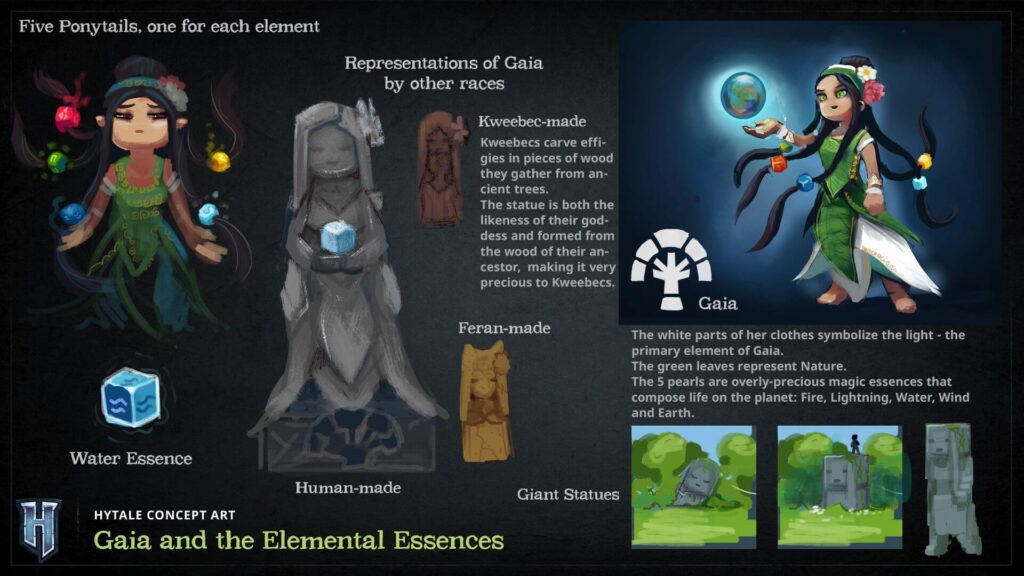
Gaia’s visual design is rich with symbolism. She appears as a woman with long black hair braided into five ponytails, each adorned with a colored pearl – one for each of the five elements she embodies:
- fire
- water
- lightning
- wind
- earth
Her clothing carries equal meaning: green fabric represents nature, white represents light , and the golden spirals woven into her garments symbolize sound (the primordial force from which Gaia herself was born, apparently). In official artwork and promotional material, she is almost always shown holding a globe of Orbis in her right hand, watching it closely. It is an image that captures her role precisely: not a distant deity, but an attentive guardian with the world literally in her hands.
Hytale Gaia & the Elements
The elemental system in Hytale is one of its defining mechanical and narrative layers and Hytale Gaia sits at its center. Of the six known elements in the game, Gaia is directly connected to five. The sixth element (void) stands in direct opposition to her, associated with corruption and the antagonistic forces threatening Orbis.
Additionally, each of Hytale’s zones carries an elemental affinity, and Zone 1 carries the earth element – Gaia’s own. It is no coincidence that this is the starting zone: lush, life-filled, and home to the structure most directly tied to Hytale Gaia. The known zone-element correspondences so far:
- Zone 1 – emerald wilds – earth (Gaia)
- Zone 2 – howling sands – wind
- Zone 3 – whisperfrost frontiers – water / ice
- Zone 4 – devastated lands – fire
In concept art, elemental runes can be seen surrounding a Gaian portal, reinforcing how deeply Gaia’s influence runs through the world’s magical infrastructure.
Culture in Hytale: Gaia Worship
Gaia is not merely a background deity. She is actively venerated by several of Orbis’s races. So far, three factions are confirmed worshippers:
- Kweebecs (Zone 1) – carving wooden Gaia effigies from ancestral timber
- Ferans (Zone 2) – worship confirmed via concept art
- humans – third confirmed devotee faction
Kweebecs are the most visibly devout. These tree-like humanoids inhabiting Zone 1 carve small wooden Hytale Gaia statues from the timber of their ancestral trees, an act that makes each effigy doubly sacred. The Gaia statue is treated as a precious object within their communities. Kweebec culture and their Gaia worship are so intertwined that the tribe maintains a physical presence at the forgotten temple itself. Ferans (the small fox-like humanoids of the howling sands) are also confirmed worshippers, as depicted in concept art. Humans round out the three known devotees.
What ties all three together is the evidence of longevity: ancient Hytale goddess statues scattered across the world, already crumbling when players arrive, suggest that worship of Gaia predates the current age of Orbis by a considerable span. These ruins carry meaning long before players understand what they represent.
Is There A Hytale Temple of Gaia?
During development, the structure that we now call the forgotten temple was widely known as the Hytale temple of Gaia. The name still circulates in the community and accurately reflects its lore significance. In the current early access build, the official name was changed to the forgotten temple, though the connection to Hytale Gaia remains fully intact. If you come across a mysterious structure and it checks all these criteria, you’ve found the temple:
- massive floating island of earth with ruined temple on top
- inhabited by Kweebecs
- corrupted golem at the center of the garden of elements
- two dungeons below (story dungeon + world dungeon)
What makes the Hytale Gaia temple structurally unique is its status as a story prefab: unlike the procedurally scattered dungeons and camps of Orbis, the forgotten temple is guaranteed to spawn in every world seed.
The Garden of Elements
At the heart of the forgotten temple lies the garden of elements: a central courtyard overgrown with striking purple vegetation. Five towers ring the garden, each representing one of Hytale Gaia’s five elements (earth, wind, water, fire, lightning). In the center stands a large golem corrupted by void magic, one of the first significant combat encounters players face inside this structure.
The contrast between the garden’s original purpose (a sanctuary representing elemental balance) and its current corrupted state is one of Hytale’s clearest examples of environmental storytelling. The Hytale Gaia temple was built to embody harmony; what players find inside is a sacred place under siege from the Void.
Dungeons Below the Garden
Beneath the garden of elements, the forgotten temple extends underground into two separate dungeon areas: a story dungeon in the north-west section and a world dungeon to the east. Both follow Hytale’s standard dungeon structure – chambers branching from a central room, culminating in a high-difficulty final encounter with meaningful rewards. As story prefabs, these dungeons are tied to the broader Hytale Gaia narrative and are worth prioritizing early in any playthrough.
Hytale Gaia: The Void & the Memories System
The central conflict in Hytale’s current lore hinges on absence: Orbis (the world itself, personified as Gaia) has been locked away by the Void and its curse. What players step into at the start of the game is a world in a state of suppressed potential, its guiding spirit out of reach. The hope of Gaia in Hytale is not a passive one: the game gives players a direct means of working toward her restoration.
That mechanism is the memories system. Players collect memories by encountering the creatures of Orbis – from the smallest passive animal to the most formidable void spawn – and return them to the heart of Orbis, a statue located inside the forgotten temple. The more memories a player returns, the more the world responds:
- permanent upgrades unlocking
- new rewards and crafting recipes becoming available
- at 100 Memories: recipe for ancient gateways unlocked
Varyn, the primary antagonistic force in Hytale’s lore, is directly tied to the Void and to Gaia’s imprisonment. His relationship to Hytale Gaia remains deliberately mysterious. What is clear is that Varyn’s influence and the Void’s corruption are two sides of the same threat to Orbis and dismantling that threat runs through Gaia herself.
FAQ
‘Hytale Gaia’ is the Avatar of Orbis, the world’s living spirit in personified form. She is the central lore figure of the game, worshipped by multiple factions and connected to five of the six known elements.
No, Gaia herself does not appear as a combat encounter. The most notable enemy tied to her is the corrupted golem at the center of the garden of elements inside the forgotten temple.
The temple of Gaia is the development-era name for the forgotten temple: a guaranteed story structure in Zone 1 containing the garden of elements, Kweebec inhabitants and dungeons below. The name changed for early access, but the structure remains unchanged.
Kweebecs, Ferans and humans are confirmed worshippers. Kweebecs are the most devout, carving wooden Hytale Gaia statues from the timber of their ancestral trees.
Gaia is represented by five ponytails with beads in them, each corresponding to one element: fire, water, lightning, wind and earth. The sixth element (void) is her antagonistic opposite and the source of the corruption players encounter throughout Orbis.
The memories system is how players help restore Orbis, while Gaia is imprisoned by the Void. By recording encounters with creatures and submitting them at the heart of Orbis inside the forgotten temple, players unlock rewards and gradually help the world recover.
The World Is Watching
Hytale: Gaia is the quiet constant beneath everything in Orbis: the reason Zone 1 feels alive, the foundation of the elemental framework, the figure carved into Kweebec wood and written into ancient stone across the land. Her influence runs from the floating ruins of her temple to the deepest layer of Hytale’s storytelling philosophy, a world that reveals itself through exploration on your hosted Hytale server – one memory at a time.
similar articles

Hytale

