Minecraft Sculk
Minecraft sculk is a family of blue-black blocks that grows, listens, and occasionally screams at you. Found exclusively in the deep dark biome deep below Y=0, sculk is the backbone of the game’s vibration detection system: sensors pick up every footstep and sneeze, catalysts convert mob XP into new sculk blocks, and shriekers trigger the warden when you push your luck too far.
Overview Minecraft Sculk:
Minecraft Sculk – The Block Family
In Short:Always use a hoe to mine any sculk block. It’s the fastest tool across the entire family. Without silk touch, you get XP. With silk touch, you get the block.
Sculk isn’t a single block but a whole ecosystem. Each member has a distinct role, and knowing which one does what will save your life more than once. Here’s the full lineup:
| Block | Function | Mining tool | Drop (no silk touch) | Drop (silk touch) |
| sculk | basic floor block; generates naturally or grows from catalysts | hoe (fastest) | 1x XP | block itself |
| sculk vein | thin decorative overlay, creeps up walls and ceilings like vines | hoe (fastest) | nothing | block itself |
| sculk sensor | detects vibrations in an 8-block radius; emits redstone signal | hoe (fastest) | 5x XP | block itself |
| calibrated sculk sensor | crafted upgrade; filters for a specific vibration frequency via redstone input; 16-block range | hoe (fastest) | 5x XP | block itself |
| sculk catalyst | converts nearby mob XP into new sculk blocks on death; detection range 8 blocks (Java) / 10 blocks (Bedrock) | hoe (fastest) | 5x XP | block itself |
| sculk shrieker | alarm block; natural shriekers summon the warden; player-placed ones are harmless | hoe (fastest) | 5x XP | block itself (loses summon ability) |
Minecraft Sculk Biome: The Deep Dark
The deep dark is the only place where sculk generates naturally. It’s a cave biome found exclusively below Y=0, with a floor carpeted in sculk patches, sensors, catalysts, and shriekers. The deeper you go and the further you are from oceans or rivers, the higher the chance of finding it, since the deep dark prefers low-erosion terrain like mountain peaks and plateaus projected underground.
The biome produces almost no natural light. Regular mob spawns are completely suppressed here. The warden is the only mob that ever appears, and it only does so when summoned by shriekers. Inside the biome, ancient cities generate at around Y=-52: massive deepslate structures filled with rare loot and more sculk than anywhere else in the world. The ancient city is the primary source of sculk catalysts and the densest concentration of sculk shriekers you’ll find.
Java vs. Bedrock:Sculk biome generation is identical across editions. The key mechanical differences appear in individual blocks, particularly the catalyst’s detection range (8 blocks Java, 10 blocks Bedrock).
How to Find and Mine Sculk in Minecraft
Finding sculk means finding the deep dark. Two approaches work: explore naturally until you see blue-black bioluminescent patches in a cave below Y=0, or use commands to skip the search entirely. In Java Edition with cheats enabled:
/locate biome minecraft:deep_dark

/locate structure minecraft:ancient_city
Once you’re there, mining sculk is straightforward. Hoes are the fastest tool across the entire sculk family. A wooden hoe already outpaces pickaxes and shovels on sculk blocks. The golden hoe is technically the fastest, though durability makes it impractical for large harvests.
The key decision is always the same:
- No silk touch: block breaks, drops XP orbs (1x from sculk and sculk vein, 5x from sensor / catalyst / shrieker)
- silk touch: block drops as an item, the only way to move it to a new location
Tip:Sculk shriekers mined with silk touch lose their can_summon tag permanently. A shrieker you pick up and re-place will never call the warden, making it safe for decorative or redstone use anywhere in your base.
How Sculk Spreads in Minecraft
Sculk spreads through a charge system driven by the sculk catalyst. When any XP-dropping entity dies within the catalyst’s detection range, its XP is converted into sculk charges rather than dropping as orbs. Those charges travel outward through adjacent blocks, converting them into sculk or sculk vein as they go. A secondary bloom also has a small chance of generating sculk sensors and sculk shriekers on top of newly-converted sculk. Up to 1,000 charges can be stored inside a single sculk block at once.
The spread has a few rules worth knowing:
- sculk can overwrite most natural blocks (stone, dirt, deepslate) but not all – it can’t spread through fire, soul fire, or certain non-solid blocks
- only the nearest sculk catalyst blooms if multiple catalysts are within range of the same death
- the ender dragon’s death still drops XP normally, sculk catalysts don’t intercept it
- sculk charges are lost when the block they’re stored in is destroyed
How to spread sculk intentionally:Place a sculk catalyst in your target area, then kill XP-dropping mobs within 8 blocks (Java) or 10 blocks (Bedrock) of it. The more XP the mob drops, the more sculk generates. This is the core mechanic behind all sculk XP farms.
The Minecraft Sculk Sensor
The Minecraft sculk sensor is a bioluminescent block that detects vibrations in an 8-block spherical radius and converts them into a redstone signal. It’s the ears of the sculk family and one of the most versatile wireless redstone components in the game.
What the Sculk Sensor Detects
Almost every in-game action generates a vibration that the sculk sensor can pick up. The sensor assigns each event a frequency value between 1 and 15. Paired with a comparator, you can identify exactly which event fired:
| Frequency | Example events |
| 1 | Mmovement (step, swim, elytra glide, crawl, fall on ground) |
| 2 | landing on ground (from a jump or fall) |
| 3 | item interaction (picking up, dropping, launching projectile) |
| 4 | projectile landing or hitting a block |
| 5 | mob or player taking damage |
| 6 | mob or player death |
| 7 | block placing |
| 8 | block breaking |
| 9 | crafting table, smithing table, or other block usage |
| 10 | container interaction (open/close chest, barrel, etc.) |
| 11 | eating or drinking |
| 12 | mob or player equipping gear |
| 13 | mob or player mount / dismount |
| 14 | piston extension or retraction |
| 15 | bell ringing, explosion, lightning strike |
The sensor emits a redstone signal of strength 15 for any detected vibration; the comparator output shows the frequency value of the specific event.
Wool Occlusion: How to Block the Sculk Sensor
Placing a block of wool or a carpet between a vibration source and the sensor completely blocks signal transmission. This is called occlusion. The game draws a straight line between the sensor’s center and the vibration source: if that line passes through any wool block, the vibration is silenced. Walking on carpet also produces no vibration at all, making carpeted floors the standard survival technique in the deep dark.
Important:Sculk sensors in Java Edition do not detect vibrations from other sculk family blocks or from the warden itself. In Bedrock Edition, this behavior can differ slightly.
Sneaking & the Sensor
Sneaking silences most low-frequency vibrations (frequencies 1-3): movement, landing without damage, most item interactions, and projectile firing. It does not silence all vibrations; breaking blocks, placing blocks, opening containers, and eating still fire at their respective frequencies even while sneaking. In short: sneaking makes you quiet, not invisible.
Waterlogging the Sensor
A waterlogged Minecraft sculk sensor still detects vibrations and emits redstone signals normally, but produces no sound itself. This is useful when you want silent wireless redstone circuits that don’t announce their presence.
The Minecraft Sculk Catalyst
The Minecraft sculk catalyst is the growth engine of the sculk family. It has a light level of 6 and emits faint soul particles when idle. When any living entity dies within its detection range, it blooms: converting the mob’s XP into sculk charges and spreading new sculk blocks outward through nearby natural terrain.
Where to Find the Sculk Catalyst
Sculk catalysts generate naturally in the deep dark biome and inside ancient cities. They can also be found in ancient city chests. The only renewable source is the warden, which drops exactly 1x sculk catalyst on death and is unaffected by looting.
Java vs. Bedrock: Catalyst RangeThe sculk bloom triggers for any entity death within 8 blocks in Java Edition and within 10 blocks in Bedrock Edition. All other mechanics are shared between editions.
What the Sculk Catalyst Generates
A sculk bloom converts natural blocks (stone, dirt, deepslate, etc.) beneath the dead entity into sculk. Additional sculk veins spread further out. Occasionally, the bloom also produces sculk sensors and has a 1% chance per new sculk block of generating a sculk shrieker. Those catalyst-generated shriekers are permanently harmless: their can_summon tag is always set to false.
The amount of spread scales directly with the entity’s XP value. Killing a single zombie near a catalyst produces a small patch; running a full mob grinder produces a spreading sculk floor. There is no XP loss from conversion: all XP becomes sculk charges at a 1:1 ratio. One charge = one block’s worth of sculk coverage.
The Minecraft Sculk Shrieker
The minecraft sculk shrieker is the alarm bell of the deep dark. It activates when a player steps on its center panel (even while sneaking) or when a nearby sculk sensor sends it a player-triggered vibration signal. When it goes off, it shrieks for 90 game ticks (4.5 seconds), applies the darkness effect to all players in survival or adventure mode within 40 blocks for 12 seconds, and potentially summons the warden.
The Warning Level System
The warden isn’t summoned on the first shriek. The game tracks a warning level per player (not per shrieker). Each natural shrieker activation adds 1 to your personal count. At warning level 4, the game attempts to spawn a warden near the activating shrieker. Critically:
- warning levels are global: triggering four different shriekers counts as four activations
- warning level decreases by 1 every 10 minutes if no shriekers are triggered
- after a warden spawns, the warning level does not reset: additional activations can summon more wardens
- there is a 10-second per-player cooldown between activations on the same shrieker
Critical: Don't mine a shrieking shriekerBreaking a sculk shrieker mid-shriek forces an immediate warden spawn attempt. Do not try to silence a shrieker by mining it in a panic.
Natural vs. Player-Placed Shriekers
This distinction is the most important thing to understand about the minecraft sculk shrieker. Only naturally generated shriekers in the deep dark have can_summon = true. No shrieker will summon a warden, if it was:
- mined with silk touch and re-placed by a player
- generated by a sculk catalyst bloom
Those will also never apply the darkness effect, and are completely safe to use in builds. This makes player-placed shriekers ideal for decorative builds, sound-effect triggers, and base security systems that don’t escalate into warden summons.
The Calibrated Sculk Sensor
The calibrated sculk sensor is a crafted upgrade that adds frequency filtering to the standard sensor. Its recipe requires 1x sculk sensor and 3x amethyst shards arranged horizontally in a crafting grid:
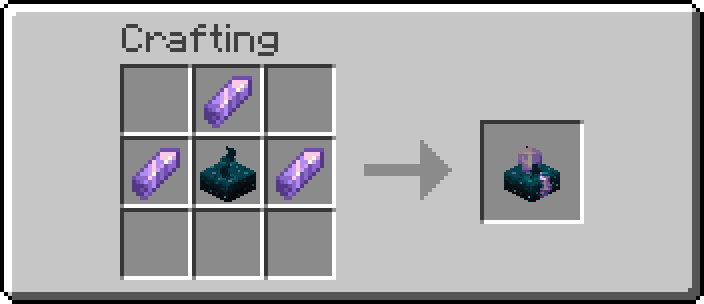
The calibrated version has a detection range of 16 blocks (double the standard sensor) and detects multiple vibrations in quicker succession. Its key feature is the input face: apply a redstone signal of strength 1-15 to that face, and the sensor will only respond to vibrations matching that frequency. All other vibrations are ignored. Combined with a daylight detector, comparator bank, or player-controlled lever array, you can make a sensor that listens for exactly one type of event and ignores everything else.
Amethyst relay chains:Placing a block of amethyst next to any sculk sensor causes the amethyst to re-emit detected vibrations at the same frequency. This allows you to chain sensor-amethyst pairs to transmit a vibration signal across long distances wirelessly, no redstone dust required.
FAQ
Sculk is a family of blue-black blocks that generate naturally in the deep dark and grow from sculk catalysts when XP-dropping mobs die nearby. The family includes the basic sculk block, sculk vein, sculk sensor, calibrated sculk sensor, sculk catalyst, and sculk shrieker.
The minecraft sculk biome is the deep dark: a cave biome found exclusively below Y=0. It has no natural light, suppresses regular mob spawning, and contains ancient cities. The sculk block family generates here exclusively.
Use a hoe. It’s the fastest tool for every sculk block. Without silk touch, sculk breaks into XP. With silk touch, it drops the block itself. Note that shriekers mined with silk touch lose the ability to summon the warden.
Place a sculk catalyst in any location and kill XP-dropping mobs within 8 blocks (Java) or 10 blocks (Bedrock). The catalyst converts the mob’s XP into sculk and spreads new blocks around it.
Apply a redstone signal of strength 1-15 to the input face of a calibrated sculk sensor. The number sets the frequency it listens for. Frequency 11, for example, detects only eating and drinking; everything else is ignored.
Minecraft sculk can spread to most natural solid blocks: stone, deepslate, dirt, gravel, sand, and similar. It can’t spread through fire, soul fire, or blocks that are part of the sculk family already (it won’t double-convert them).
Sculk was introduced in Minecraft 1.19 ‘The Wild’ Update (June 2022), alongside the deep dark biome, ancient cities, and the warden. The calibrated sculk sensor was added later in Java Edition 1.20 / Bedrock 1.20.
Sculk Knows Where You Live
Sculk turns a dark cave into a full system: the floor banks XP, the sensors map every footstep, the catalysts grow new blocks from death, and the shriekers keep a running tally of your mistakes. Once you know how each piece connects, the deep dark stops being a place you survive by luck and starts being a place you can exploit on purpose. Whether you’re running a sculk XP farm, building a calibrated sensor contraption, or just trying to loot an ancient city without waking anything up, the rules are the same: understand the system, respect the warden, and keep your footsteps off the redstone. Put it all into practice on a Minecraft server from GPORTAL.
similar articles

Minecraft
BetterMC

Minecraft