Minecraft Deepslate
Minecraft deepslate is the dark, dense stone that takes over the underground once you dive below Y=0 in the overworld. It is harder to break than regular stone, spawns its own family of deepslate ore variants and decorative blocks and has even grown into strange forms like reinforced deepslate and infested deepslate, making deepslate one of the most important materials for late-game mining, building and exploration in modern deepslate Minecraft worlds.
Overview Minecraft Deepslate:
Minecraft Deepslate: A Short History
Deepslate first appeared in early ‘Caves & Cliffs’ snapshots under the name ‘grimstone’, before being officially renamed to deepslate in snapshot 21w08a. At that point, it started dropping cobbled deepslate instead of itself and became the base material for all the new deepslate variants. With ‘Caves & Cliffs: Part II’, world generation changed so that deepslate makes up most solid blocks below Y=0. Existing worlds that are upgraded now have their old Y=0 bedrock layer replaced with deepslate and new caves underneath. Later, the ‘Wild’ update (Minecraft 1.19) added the deep dark biome and ancient cities, which brought reinforced deepslate into the game as an unbreakable, portal-shaped frame block at the heart of those structures.
What Deepslate Looks Like
Deepslate is a stone-type block with a dark gray, layered texture that looks like compressed shale or slate. It is slightly rougher and higher contrast than normal stone and can be placed along different axes, so the ‘layers’ can run horizontally or vertically, which is useful when you shape deepslate corridors or cave walls.
Basic and Cobbled Deepslate
Basic deepslate generates as a solid mass deep underground and behaves a bit like stone, just tougher. If you mine deepslate with a pickaxe without silk touch, it drops cobbled deepslate instead of itself. Only a pickaxe enchanted with silk touch lets you pick up the original deepslate block.
Cobbled deepslate has a chunky, broken-rock texture similar to cobblestone and is sometimes casually called ‘deepslate stone’ by players. It can be used in many recipes that accept cobblestone, like furnaces, brewing stands and stone tools, but still cannot craft dispensers, droppers or pistons.
Decorative Deepslate Blocks
Once you have cobbled deepslate, an entire decorative family opens up that works a bit like darker bricks or blackstone. These are the main decorative variants:
- polished deepslate
- deepslate bricks and cracked deepslate bricks
- deepslate tiles and cracked deepslate tiles
- chiseled deepslate
All of these decorative blocks have slab, stair and wall variants, giving you a full dark block set for deep bases and moody builds.
Deepslate Ores and Special Variants
Whenever an ore generates inside deepslate, it automatically becomes a deepslate ore variant. This applies to:
- deepslate coal ore
- deepslate iron ore
- deepslate copper ore
- deepslate gold ore
- deepslate redstone ore
- deepslate lapis lazuli ore
- deepslate diamond ore
- deepslate emerald ore
They use the same ore patterns as their stone versions but sit in a much darker background and have higher hardness, so mining them takes longer.
In addition to the deepslate ores, there are also some special variants of deepslate. Two special variants are worth calling out:
- reinforced deepslate: generates only in ancient cities as the frame of the so-called reinforced deepslate portal, that currently has no function; has higher hardness than obsidian, is immune to explosions and cannot be obtained legitimately in survival
- infested deepslate: deepslate block that contains a silverfish; looks like normal deepslate, but breaks much faster and releases a silverfish when mined, similar to other infested stone variants
Where to Find Deepslate in Minecraft
Deepslate makes up most of the overworld underground below Y=0 in current versions. Stone is gradually replaced by deepslate between about Y=8 and Y=0, and deeper than that you will mostly see dark deepslate stone instead of gray stone. The vertical distribution of deepslate follows a clear pattern in modern world generation:
- above Y=8 you mostly find regular stone and its variants
- between Y=8 and Y=0, stone and deepslate blend into each other as the game transitions into the deep layer
- from Y=0 down to roughly Y=-64, deepslate becomes the dominant block in most chunks
When old worlds are upgraded to ‘Caves & Cliffs: Part II’, the old bedrock line around Y=0 is removed and replaced with new caves and a deepslate layer below, so even legacy survival worlds gain access to deepslate without starting over.
Biomes, Structures and Deepslate Ore Hotspots
Deepslate itself has no biome restrictions. It generates in all overworld biomes, so every deep cave system will eventually transition to deepslate. Some deepslate variants and ores are more specific:
- ancient cities – usually around Y≈-51, full of polished deepslate, bricks, tiles and reinforced deepslate
- deepslate emerald ore – only occurs where emerald ore replaces tuff or deepslate between Y=-16 and Y=8
- deepslate coal ore appears when coal ore replaces tuff or deepslate below Y=8
Deepslate Variants at a Glance
Minecraft deepslate comes with a surprising number of variants plus slabs, stairs and walls for most of these and several deepslate ore versions. To keep track of them all this overview groups related blocks together:
| variant / group | how to get | look |
| deepslate | mine with silk touch | dark layered ‘deep stone’ with directional texture |
| cobbled deepslate | mine deepslate without silk touch, found in ancient cities, loot chests | rough cobblestone-like deepslate stone |
| polished deepslate | crafted, found in ancient cities | smooth, lined polished deep slate |
| deepslate bricks / cracked deepslate bricks | crafted; found in ancient cities | classic brick pattern; cracked version looks weathered |
| deepslate tiles / cracked deepslate tiles | crafted; found in ancient cities | tight, grid-like tiles; cracked tiles with fractures |
| chiseled deepslate | crafted or stonecut | carved block with face-like motif |
| slabs / stairs / walls (all deepslate types) | crafted or stonecut; found in ancient cities | half-height blocks, steps and walls matching parent block |
| reinforced deepslate | found ‘reinforced deepslate portal’ frame in ancient cities | very dark, framed pattern with subtle inner square |
| infested deepslate | found underground near some strongholds / mountain areas | identical to normal deepslate |
| deepslate ore – coal, iron, copper, gold | found where normal ores intersect deepslate/tuff | normal ore pattern on a dark deepslate background |
| deepslate ore – redstone, lapis lazuli | found in deep cave systems | bright red or blue ore flecks in dark deepslate |
After looking at the table, you can see how broad the deepslate minecraft block family really is: from basic deepslate stone and cobbled deepslate up to exotic reinforced deepslate and deepslate emerald ore, almost every deep block you meet underground belongs to one of these groups.
Mining Deepslate
Mining in the deepslate layer feels slower than in normal stone layers, partly because every deepslate block is harder and partly because each deepslate ore variant takes longer to break than its stone equivalent. Before you start digging long tunnels through deepslate, it helps to know how tools and drops behave for the main groups:
| block group | tool needed | drop without silk touch | drop with silk touch |
| deepslate | any pickaxe | cobbled deepslate | block itself |
| cobbled / polished / bricks / tiles / chiseled | any pickaxe | block itself | block itself |
| slabs / stairs / walls (all deepslate variants) | any pickaxe | slab, stair or wall block itself | the same block |
| deepslate ore – coal, iron, copper, gold | stone or iron pickaxe | coal, raw iron, raw copper or raw gold | corresponding deepslate ore block |
| deepslate ore – redstone, lapis lazuli | iron pickaxe or better | 4–5x redstone dust or 4–9x lapis lazuli | corresponding deepslate ore block |
| deepslate ore – diamond, emerald | iron pickaxe or better | diamond or emerald item | corresponding deepslate ore block |
| reinforced deepslate | no tool works in survival | nothing | nothing |
| infested deepslate | any tool or bare hand | silverfish (mob), no block | silverfish (mob), no block |
In short, you can treat almost every decorative deepslate block the same way when you mine it, while deepslate ore behaves like the stone ore you already know, just slower to break and darker to see. The only big exceptions are reinforced deepslate, which you can’t harvest at all, and infested deepslate, which is more of a silverfish delivery service than a useful building block.
Crafting with Deepslate: From Cobbled to Tiles
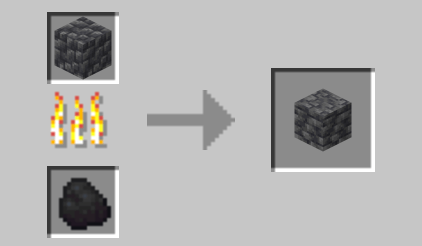
Crafting deepslate blocks mostly starts with cobbled deepslate. Even though you can’t craft raw deepslate directly out of nothing, you effectively ‘make deepslate’ by smelting cobbled deepslate in a furnace, which is the closest answer to how to make deepslate in survival.
cobbled deepslate → deepslate
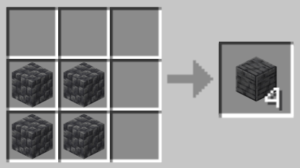
Many players want to craft polished deepslate because it is a clean building block. The recipe is simple:
4x cobbled deepslate = 4x polished deepslate
If you already have a stonecutter, you can also feed cobbled deepslate into it and directly cut polished deepslate from a single block, which is more material-efficient than crafting. Polished deepslate itself can then be turned into slabs, stairs and walls, either via crafting table recipes or again with the stonecutter for more precise output. The basic progression from cobbled deepslate to tiles looks like this:
cobbled deepslate → polished deepslate → deepslate bricks → deepslate tiles
Step 1: Craft polished deepslate from cobbled deepslate.
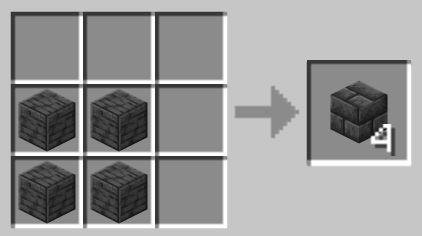
Step 2: Craft deepslate bricks from polished deepslate.
4x polished deepslate = 4x deepslate bricks
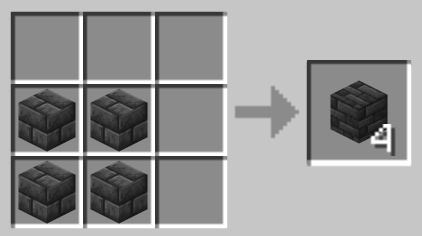
Step 3: Craft deepslate tiles from deepslate bricks.
4x deepslate bricks = 4x deepslate tiles
If you prefer the ‘weathered’ look, you can smelt deepslate bricks to get cracked deepslate bricks:
deepslate bricks → cracked deepslate bricks
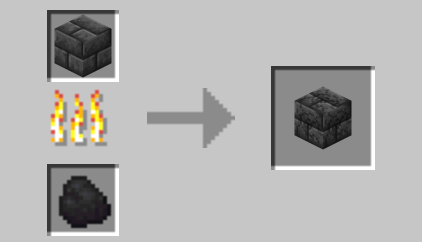
You can also smelt deepslate tiles to get cracked deepslate tiles:
deepslate tiles → cracked deepslate tiles
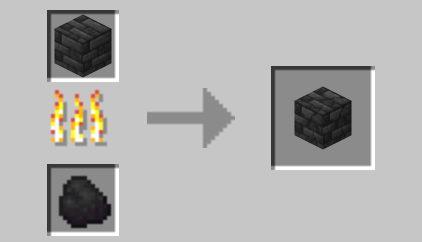
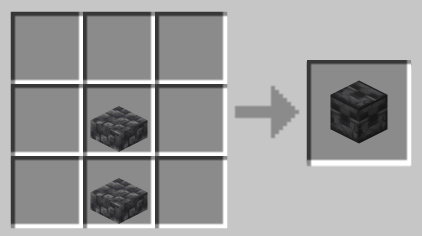
Both cracked variants also show up in ancient cities as part of the natural ruined aesthetic. Finally, chiseled deepslate is crafted by stacking two cobbled deepslate slabs on top of each other in a crafting grid, or by cutting it directly from cobbled deepslate in the stonecutter.
2x cobbled deepslate slabs = 1x chiseled deepslate
Building and Gameplay Uses for Deepslate
Deepslate is more than just annoying hard stone in the way of your branch mine. It is a full building palette, a signal that you have entered the rare ore zone and a backdrop for some of the scariest structures in the game. If you like darker builds, deepslate variants are a perfect match for nether bricks, blackstone and other dark blocks, tying in nicely with general aesthetics. You can, for example, use:
- polished deepslate for structural frames and pillars
- deepslate bricks and cracked deepslate bricks for fortress walls
- deepslate tiles for roofs and floor patterns
Mixing these with lighter accents like calcite or tuff creates strong contrast without leaving the deepslate style.
Mining in the Deepslate Layer
From a gameplay perspective, deepslate is your visual cue that you are deep enough for late-game ores. Most diamonds and redstone veins appear in the deepslate layer. So, it is perfect for some mining and stocking up your inventory. Here, you will regularly encounter deepslate diamond ore, deepslate iron ore, deepslate copper ore and deepslate gold ore mixed into the rock, with redstone and lapis lazuli ore sprinkled in various pockets.
Note Blocks, Sounds and Technical Quirks
Like stone and most ores, deepslate blocks and deepslate ore under a note block produce the ‘bass drum’ sound, letting you integrate them into redstone music builds without changing your sound palette. Reinforced deepslate, on the other hand, is mainly a lore block that map makers sometimes use in custom ‘reinforced deepslate portal’ designs because of its unbreakable nature. Since it can’t be mined or moved in survival, it is safe to treat it as permanent terrain whenever you explore ancient cities.
FAQ
Wherever the overworld terrain dips below Y=0. Stone is gradually replaced between Y=8 and Y=0, and from there downwards the underground is dominated by deepslate.
Either mine it with a silk touch pickaxe or smelt cobbled deepslate in a furnace to turn it back into deepslate.
Mining deepslate with a pickaxe that does not have silk touch will drop cobbled deepslate. It also appears as a natural block in ancient cities and can be obtained from their structures.
Put 4x cobbled deepslate in a square in any crafting grid. This yields 4x polished deepslate blocks. Alternatively, place cobbled deepslate in a stonecutter and select the polished deepslate output, which turns 1x cobbled deepslate into 1x polished deepslate.
First craft polished deepslate from cobbled deepslate. Then put 4x polished deepslate in a crafting grid to get deepslate bricks or use a stonecutter for a 1:1 transformation.
Craft deepslate bricks and use four of them to craft deepslate tiles. You can also cut deepslate tiles directly from deepslate bricks or cobbled deepslate using a stonecutter.
Deepslate emerald ore is considered the rarest ore in the game. It only generates where emerald ore intersects deepslate or tuff between Y=-16 and Y=8, and emerald ore itself is limited to mountain and windswept biomes.
Deepslate coal ore only generates when a coal ore vein happens to replace tuff or deepslate below Y=8. Coal veins usually spawn much higher up, so only a small fraction ever reach the deepslate layer. That makes deepslate coal ore one of the rarest naturally occurring blocks in the game.
Hitting Rock Bottom: The Deepslate Wrap-Up
Deepslate may start out feeling like the game’s way of punishing you for digging too deep, but once you understand how to get deepslate and all its other versions, it quickly becomes one of the most versatile building materials in Minecraft. It defines the look of the deepest caves, carries the rarest ores and gives ancient cities their eerie reinforced deepslate portal frames.
So the next time your pickaxe slows down and the walls turn from stone to dark deepslate stone, you are not just ‘hitting rock bottom’ in your world. You are entering the layer where diamonds shine brighter, deepslate emerald ore lurks in the shadows and your future mega-base walls practically grow out of the cave around you. If you ever wanted an excuse to go deeper on your own Minecraft server from GPORTAL, deepslate is it.


