Minecraft Bones
The Minecraft bone is one of those items that accumulates almost on its own, yet never really becomes useless. Whether you’re after an army of tamed wolves, a compact bone meal supply for your farm, or a surprisingly musical base entrance using note blocks, bones quietly power a surprising range of mechanics. This article covers every source, every use case, and what changes between Java and Bedrock, including how to get bones in Minecraft on peaceful difficulty, where no skeleton will ever bother you.
Overview Minecraft Bones:
Why You Keep Finding Minecraft Bones
In Minecraft, bones are exactly what they sound like: a drop item associated with skeletal mobs that stacks to 64, is labelled ‘common’ in game data, and has been renewable since early versions. The game does not treat them as junk (though fishing technically does). Minecraft bones sit at the junction of three entirely separate mechanics:
The result is an item that never really stops mattering, no matter how far into a playthrough you are.
How to Get Bones in Minecraft
There are three main ways to collect bones in Minecraft:
- mob drops
- chest loot in structures
- fishing
For consistent supply, mob farming is the fastest route; chest loot and fishing are useful alternatives when direct combat is not ideal or available.
1) Mob Drops – The Classic Source
The most reliable answer to ‘how to get bones in Minecraft’ is: defeat skeletons. All six skeleton-type mobs in the current version drop 0-2x bones by default. With the looting enchantment, the maximum increases by +1 per level, reaching 0-5x bones at looting III. The drop chance in Java Edition is ~66.67% for at least one bone per kill, meaning roughly two out of three kills produce bones without any enchantment. Here is a quick overview of which skeleton-type mobs drop Minecraft bones:
| Mob | Default drop | With looting III (Java) | Notes |
| skeleton | 0-2x | 0-5x | most common source; spawns anywhere at light level 0 |
| stray | 0-2x | 0-5x | cold biomes; fires slowness arrows |
| wither skeleton | 0-2x | 0-5x | Nether fortresses only; also drops wither effect on hit |
| skeleton horse | 0-2x | 0-5x | spawns during thunderstorms; kill the rider to keep the horse |
| bogged | 0-2x | 0-5x | swamp and trial chambers (Java 1.21+); fires poison arrows |
2) Chest Loot – Minecraft Bones Without Combat
If you prefer to skip the arrows, Minecraft bones also generate in chest loot across several structures. Locations in Java Edition include:
- monster rooms (dungeon chests)
- desert pyramids
- jungle pyramids
- woodland mansions
- ancient cities
This approach is slower than mob farming but is particularly useful early in a world before you have reliable combat gear. Keep in mind that most of these structures come with their own hostile mobs, so ‘no combat’ is more of a goal than a guarantee.
3) Fishing – Technically Minecraft Bones Count as Junk
Minecraft bones can also be obtained by fishing, where they sit in the ‘junk’ loot pool alongside items like leather boots and bowls. The key detail: luck of the sea shifts probability away from junk, which means your best odds of actually fishing up a bone come without that enchantment. This method is best described as a side effect of fishing, not a farming strategy.
How to Get Bones in Minecraft on Peaceful (No Killing Required)
On peaceful difficulty, hostile mobs do not spawn, which eliminates the standard skeleton drop route entirely. There are still several workable alternatives, and this section also covers how to get bones in Minecraft without killing skeletons in other game modes, for example, if you simply prefer non-combat play. Your three main options are:
- fossils in the overworld
- Nether fossils in the soul sand valley
- fishing (Bedrock Edition only) and fish mob drops
Fossils: Dinosaur Bones in Minecraft
The question of ‘dinosaur bones in Minecraft’ is technically addressed by fossils: naturally generated bone block structures that appear underground in desert and swamp biomes (y-coordinates ~40–49, roughly 15–24 blocks below the surface). Each chunk has a 1-in-64 chance of generating a fossil, which makes them genuinely rare but not impossible to find with targeted exploration.
The value here is significant: each bone block dismantled with a pickaxe yields 1x bone block, which crafts into 9x bone meal, or can be converted back into 9x regular bones via the crafting grid. A full fossil site can supply dozens of bone blocks at once, making it the most efficient single-location source for bulk bone material on peaceful.
Bedrock Note:In Bedrock Edition, you can also purchase 3x bone meal for 1x emerald from the wandering trader. Not bones directly, but a conversion-ready equivalent if you have emeralds to spare. Bedrock fish mobs (pufferfish, salmon) also have a 25% chance to drop Minecraft bones, making fishing a more viable bone source on Bedrock than on Java.
Nether Fossils & the Soul Sand Valley
As of the 1.16 Nether update, small fossil structures also generate in the soul sand valley biome inside the Nether. These Nether fossils are more common than their overworld counterparts and spawn at any y-level within the biome. On peaceful, ghasts and Nether skeletons do not spawn, which makes the soul sand valley a genuinely safe farming zone for bone blocks, provided you watch your step near lava lakes.
Minecraft Bone Uses
Bones serve three core functions: taming and interacting with wolves, crafting into bone meal, and building with bone blocks. Beyond that, a handful of specific interactions make them more interesting than most common drops.
Taming Wolves – The Minecraft Dog Bone
The most famous use of a bone in Minecraft is taming wild wolves. The mechanic works as follows: each bone offered to a wild wolf has a 1-in-3 (33.3%) chance of taming it. Taming is random and independent per bone, so there is no guaranteed number. One bone can do it; so can ten. Once tamed, the wolf gains a red collar and stops accepting bones as taming items, though you can still use a bone to get its attention and call it to your position.
Tip:Tamed wolves automatically attack skeletons and their variants even when unprovoked, meaning your wolf pack is also a bone-acquisition hazard if you’re trying to fight skeletons yourself in close quarters. Worth knowing before you build a mob farm next to your wolf pen.
Crafting Bone Meal
The simplest crafting use:
1x Minecraft bone → 3x bone meal
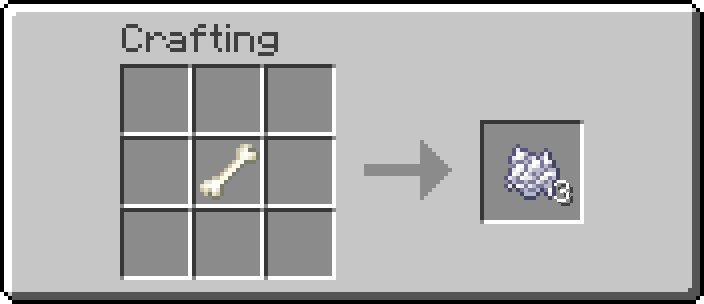
Bone meal is primarily used to accelerate plant growth (crops, saplings, sea grass, coral and more), and is one of the most universally useful mid-game consumables. If your bone supply consistently exceeds what you need for taming, converting the surplus into bone meal is almost always the right move.
Helmet Slot Easter Egg (Java Edition Only)
A Minecraft bone can’t be equipped normally in survival armor slots. In Java Edition however, using commands (specifically the /item command to replace the head slot) forces a bone into the helmet position, where it renders sticking out of the player’s mouth. It serves no mechanical purpose whatsoever and is very much the kind of detail that makes multiplayer fun.
The Minecraft Bone Block
The bone block is a separate item from the regular Minecraft bone, but the two are closely linked: 9x bone meal craft into 1x bone block, and conversely, 1x bone block dismantles back into 9x bone meal (not bones). Bone blocks have three distinct use cases:
- compact storage: storing large amounts of bone meal in block form
- decorative building: pale white/grey block with a directional grain pattern, usable in three orientations
- note block instrument: placing a note block on top of a bone block produces a xylophone sound, distinct from every other base block in the game
Bone blocks generate naturally as part of fossil structures underground in desert and swamp biomes (y-coordinates ~40–49), and as Nether fossils in the soul sand valley. As of Java Edition 1.21, bone blocks also appear in trial chambers as indicators for skeleton-type trial spawners. Breaking a bone block requires any pickaxe; breaking it with any other tool or bare hand drops nothing.
FAQ
Mostly from skeletons and skeleton variants as mob drops, plus chest loot in monster rooms, desert pyramids, jungle pyramids, woodland mansions and ancient cities, and occasionally by fishing as junk.
Find fossils underground in desert or swamp biomes (y ~40–49). Each bone block there converts to 9x bone meal via crafting. Not directly into bones. In the Nether, soul sand valley fossils are more common and spawn without hostile mobs on peaceful. Bedrock players can also buy bone meal from the wandering trader or fish for bones directly.
Chest loot in structures, fossil mining, fishing, and on Bedrock via wandering trader bone meal purchases and fish mob drops.
The core uses are taming wolves, maintaining tamed wolves‘ attention, and crafting Minecraft bones into bone meal. Also: bone blocks for builds, xylophone note blocks, and the cursed Java Edition helmet command trick.
Not directly: bones are obtained as drops or loot, not crafted. You can craft them into bone meal (1x bone → 3x bone meal), and 9x bone meal can be crafted into 1x bone block. Bone blocks do not convert back into individual bones, only into bone meal.
It varies. Each bone has a 1-in-3 chance of taming a wild wolf, so the number is random. Statistically, the average is around 3 bones, but single-bone tames and ten-bone streaks are both possible.
There are no actual dinosaur bones in Minecraft. The closest equivalent is the fossil structure, which generates underground as a pattern of bone blocks shaped like a skull or spine. The game does not specify what creature they belong to, which is part of the intentional mystery.
Minecraft Bones Are the Game’s Most Polite Bribe
Minecraft bones are what happen when the game takes something extremely basic and quietly gives it staying power. They’re common enough to accumulate without trying, useful enough to miss when they run low, and versatile enough to turn one night of skeleton encounters into farming convenience, a wolf companion, or an unreasonably musical front door. Whether you’re stocking up through a mob farm, raiding structure chests, or digging up fossils in the desert for a peaceful session, there’s always a reason to want more in your inventory. Put them to work on a Minecraft server from GPORTAL and find out just how far a stack of bones can go when you have friends to share the chaos with.