Minecraft Flint and Steel
Minecraft flint and steel is a two-ingredient tool that places fire, lights structures and ignites certain blocks and mobs. For all its simplicity, it has one of the longest résumés in the game: from opening nether portals to lighting fire for decoration, triggering TNT and forcing creepers to explode on command.
Overview Minecraft Flint and Steel:
What Minecraft Flint and Steel Does
In Minecraft, flint and steel is classified as a tool, not a weapon, even though it can absolutely ruin someone’s day. It places fire on demand and has a durability of 64, meaning 64 successful ignitions before it breaks. A few of its most common uses:
- lighting nether portals: the primary use in most survival playthroughs
- lighting campfires, candles and cakes with candles: atmosphere and decoration
- igniting TNT: the resulting explosion damage counts as the player’s attack
- forcing creepers to explode on command, which is either tactical or catastrophic depending on proximity
- spreading fire to flammable blocks for farming or clearing
Historical Note:Minecraft flint and steel is one of the game’s oldest tools. In very early versions it could even smelt ores and cook food (before furnaces took over those jobs entirely).
How to Craft Flint and Steel
The Minecraft flint and steel recipe is one of the simplest in the game. It is shapeless and can be crafted on either the 2×2 inventory grid or a crafting table. You need exactly two ingredients:
1x flint + 1x iron ingot = 1x flint and steel
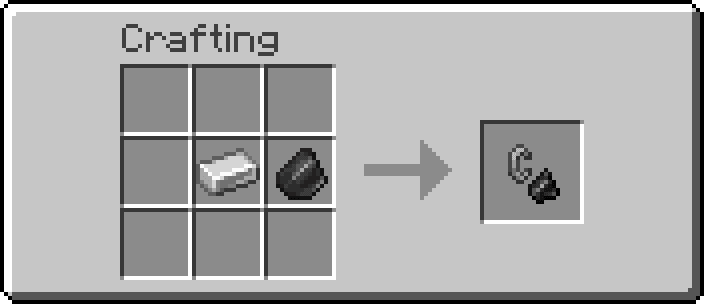
You can also combine two damaged flint and steels in any crafting grid to merge their remaining durability, which is useful when both are nearly broken. On an anvil, you can do the same while preserving enchantments from both items.
How to Get Flint in Minecraft
Flint drops from gravel blocks. Every gravel block you mine has a 10% base chance to drop flint instead of the gravel itself. The enchantment fortune scales this significantly:
| Fortune level | Flint drop chance |
| no fortune | 10% |
| fortune I | 16% |
| fortune II | 25% |
| fortune III | 100% |
Good gravel sources include riverbeds, beaches, caves, and windswept gravelly hills, all common enough that one solid patch is usually enough for all the flint you will ever need. However, there’s one important exception: a tool enchanted with silk touch prevents flint from dropping at all, so bring an unenchanted shovel or your bare hands if you want flint quickly.
How to Get an Iron Ingot
Iron ingots come from smelting raw iron in a furnace or blast furnace. Raw iron drops from mining iron ore, which is one of the most common ores in the game, generating from Y 72 all the way down to Y -64 with a peak around Y 16. If you have already progressed further, iron ingots also drop from iron golems and occasionally from zombies, husks and zombified villagers.
Finding Minecraft Flint and Steel as Loot
Crafting is not the only route. Minecraft flint and steel appears in loot chests in two structures, both accessible in the early game:
Ruined portals are common. There is one approximately every 25 chunks in virtually every biome, and their chest nearly always contains gold items, obsidian and often a ready-to-use Minecraft flint and steel. This makes them one of the best early-game discoveries: find a ruined portal, loot the chest, repair the frame and you can enter the Nether without ever crafting one.
On Bedrock Edition, every ruined portal is guaranteed to have a chest. On Java Edition, the chest can occasionally be overridden by terrain generation. It’s rare, but worth knowing if you find a portal without one nearby.
How Flint and Steel Actually Works
When you right-click with flint and steel, Minecraft checks the targeted surface and applies a specific behaviour depending on what it finds:
| Target | Result |
| solid top surface | places a fire block on top; spreads to nearby flammable blocks |
| side of a flammable block | ignites that side; block may burn away over time |
| obsidian inside a valid, unlit portal frame | fire instantly converts the entire frame into nether portal blocks |
| TNT | ignites it; explosion damage counts as the player’s attack |
| creeper | forces the creeper to immediately begin its explosion countdown |
| unlit campfire or candle | lights it |
| underwater or transparent block | no fire placed, but 1x durability is still consumed |
The spread behaviour of that fire is governed by the doFireTick gamerule. When it is on (default), fire spreads to adjacent flammable blocks and eventually burns them away. When it is off, fire neither spreads nor extinguishes naturally (useful for permanent decorative flames):
/gamerule doFireTick false
Adventure Mode Note:In adventure mode, Minecraft flint and steel can’t light fires or ignite nether portals unless the item has the tag CanPlaceOn:obsidian. It can still ignite TNT and creepers regardless of game mode.
Enchanting Flint and Steel
In survival, flint and steel can receive three enchantments, all applied via an anvil with enchanted books. No enchanting table path exists for it directly.
| Enchantment | Max level | Effect |
| unbreaking | III | each use has a chance to skip durability loss, effectively tripling the 64-use lifespan at level III |
| mending | I | repairs the item using XP orbs collected while holding it or having it in your off-hand |
| curse of vanishing | I | deletes the item on death rather than dropping it, prevents others from looting it in PvP or hardcore setups |
The practical combination for regular use is unbreaking III + mending together: with normal XP gain from everyday gameplay, a Minecraft flint and steel with both enchantments is effectively permanent. That makes it worth the anvil cost for anyone who uses it regularly for portals, farms or redstone builds.
FAQ
Loot it from chests at ruined portals in the overworld and Nether (~46% chance) or from corridor chests in nether fortresses (~19% chance).
Combine 1x flint and 1x iron ingot anywhere in a crafting grid. The recipe is shapeless, so position does not matter. Both the 2×2 inventory grid and a full crafting table work.
Mine gravel blocks. Each block has a 10% base chance to drop flint, rising to 16% at fortune I, 25% at fortune II and 100% at fortune III. Gravel is common in riverbeds, beaches and caves: one good patch covers most needs. Note: a silk touch tool prevents flint from dropping entirely.
Equip it and right-click. On a solid top surface it places fire; on the side of a flammable block it ignites that side; on obsidian in a valid frame it lights a nether portal. The same click ignites TNT, lights campfires, candles and cakes with candles, and forces creepers to explode.
64, and each successful ignition costs one durability point. Using it on water or transparent blocks also costs one durability without producing fire. Once it hits zero, the item breaks and disappears.
Yes, via an anvil with enchanted books: unbreaking (up to III), mending (I) and curse of vanishing (I). No enchanting table path exists for it.
Only partially. It can still ignite TNT and creepers in adventure mode, but can’t place fires or light nether portals unless the item has the tag CanPlaceOn:obsidian.
Strike Once, Light Everything
Minecraft flint and steel is easy to overlook until you suddenly need it. For the cost of one flint and one iron ingot, you get a tool that opens dimensions, powers farms, decorates bases and fuels some of the most interesting (and funniest) moments in the game. It is older than most other tools in Minecraft, but every new block that can be lit, from campfires to candles, just makes it more useful. Carry it into the Nether, keep it near your build, and enchant it with unbreaking and mending if you use it regularly. The mansion stays standing as long as you keep your finger off the trigger unless you’re playing on a Minecraft server from GPORTAL, in which case the fire spread is entirely your business.


