Minecraft Fossils
Deep within Minecraft, something ancient sleeps, waiting for the day the surface remembers it again. Its white bone blocks belong to a species unknown yet terrifying, even though only their Minecraft fossils remain. Could these blocks be proof that creatures far more terrifying than even the strongest skeleton of today once roamed the prehistoric biomes of this world? Or are they simply elaborate hoaxes, placed by the developers to confuse the many players of this game?
If you are curious about fossils in Minecraft, then let us show you just how deep this rabbit hole goes. What created them? How do you find them? What do all Minecraft fossils have in common and what sets the rare diamond variant apart? Are Minecraft fossils white gold or useless bone meal of yesterday?
Overview Minecraft Fossils:
What Are Minecraft Fossils?
Fossils are rare and mysterious structures or so you might think! Even here, we can find some pieces of information that hint at the Minecraft fossil’s true nature. As it turns out, they are not structures as we understand them, but pseudo-structures in the overworld, meaning they always generate even if the Generate Structures option is turned off. But the confusion doesn’t end there: in the Nether, the same bone mountains are treated as proper structures. What could cause them to behave so differently between the two dimensions? Could this hint at an infernal origin for these gigantic bone formations? At this point, anything is possible.
Before we chase that mystery down a dark tunnel, here’s what the game files can tell us: not all Minecraft fossils look alike. The overworld version comes in eight official shapes:
- four different skulls
- four different spines
Each generated from a bone layer with about 90% integrity, giving every MC fossil that characteristic ruined, incomplete look. The Nether is even more varied:
- 14 separate fossil formations lying scattered across the soul sand wastelands
So when you think you’ve seen all Minecraft fossils, chances are there are still a few skeletal giants left to discover.
How to Find Fossils in Minecraft
Of course, you should conduct your own research into the mysterious origins of these bones. But to do that, you have to find them first and that’s trickier than it sounds. Before breaking out the pickaxe, it helps to know where each type spawns, what depth hides the rarest variants, and which tools can cut your search time in half.
Minecraft Fossil Overworld Locations
Where to find fossils in Minecraft usually comes down to three biomes. The Minecraft fossil overworld generation sticks to:
- deserts
- swamps
- mangrove swamps (Java Edition only)
Every chunk inside these biomes rolls two separate spawn attempts: one that can place a fossil anywhere between Y=0 and Y=320, and another that targets the deep underground between Y=-63 and Y=-8. In practice, almost every fossil you’ll ever see is of the second kind buried in stone or deepslate, usually only visible where caves and ravines have exposed a few of its bones.
Minecraft Nether Fossils in Soul Sand Valleys
In contrast, Minecraft nether fossils spawn exclusively in soul sand valleys. They’re far easier to spot than their overworld cousins because they generate above the surface, right in plain view of passing striders. Just wander a soul sand valley for a few minutes. They typically appear at Y-level 44 and above, and never below Y=37.
Unlike the overworld version, Nether fossils contain no ore at all, only pure bone blocks. So while they give you less variety in loot, they’re also far less work to harvest.
The Minecraft Diamond Fossil
Now for the jackpot: the Minecraft diamond fossil is the rarest variant of all. And yes, it absolutely exists in vanilla Minecraft. Here’s how it actually works. When an overworld fossil generates, 10% of its bone blocks are replaced with ore. Above Y=0, that ore is coal. Below Y=-8, the game swaps in deepslate diamond ore instead. The diamond ore is part of the fossil itself, woven right into the skeletal structure. Any fossil that generates below Y=-8 qualifies as a Minecraft diamond fossil, but your best hunting ground is between Y=-40 and Y=-58 – the same sweet spot miners use for regular diamond veins.
Using A Minecraft Fossil Finder
If the thought of blindly branch-mining hundreds of chunks sounds exhausting, you’re not alone. Minecraft experts agree that the fastest way to track one down is a Minecraft fossil finder like chunkbase. Plug in your world seed, pick your version, and the app maps every fossil in the area, overworld diamonds included.For purists, branch mining between Y=-40 and Y=-58 works almost as well for the diamond variant. The /locatecommand is only partially helpful:
/locate structure minecraft:nether_fossil
The command pinpoints Nether skeletons in seconds, but the overworld version is classified as a feature rather than a structure, so the command simply won’t find it.
What Can You Do with Minecraft Fossils?
Once you’ve found an MC fossil, the true challenge begins: making use of the bones. In modern Minecraft societies, the coal that spawns with these fossils powers torches, fuels furnaces and drives trade. Diamonds feed all kinds of crafting projects, including high-grade gear. Bone meal finds much use in agriculture, being the ideal fertilizer, and bright dyes often need it to hit the right color.
But simply using Minecraft fossils for their most logical purpose is only half the fun. This is precisely why we’re proud to present some of the most intriguing uses for the MC fossil.
Minecraft Fossil Builds
Fossils in their natural state are already fascinating, but rearranging them opens up a world of possibilities. A few of our favourite Minecraft fossil builds:
- reconstructed dinosaurs: T-rex silhouettes and sprawling sauropod skeletons – the closest thing to a dinosaur fossil Minecraft vanilla will ever allow.
- museum displays: in-game exhibitions of dinosaur bones Minecraft style, with signs, lore placards and room for villagers to admire.
- spooky decor: eerie centrepieces for Halloween scenes or haunted houses.
- monumental structures: pale arches and gates that turn any settlement into a city of marble.
How to Build A Fossil in Minecraft
Wondering how to build a fossil in Minecraft from scratch? Start by stocking up on bone blocks:
9x bones = 1x bone block
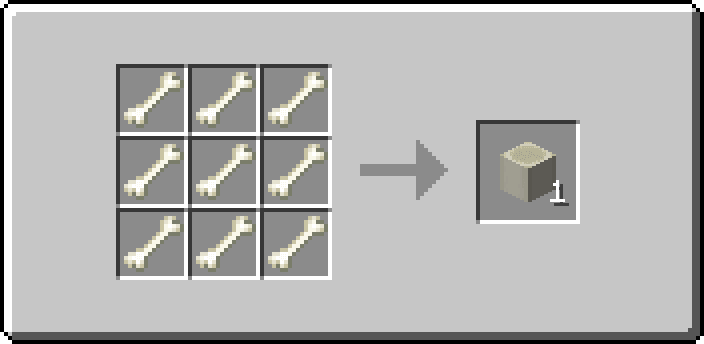
A full fossil site can yield dozens of blocks once you strip and recycle the surrounding bone meal. From there:
- lay down the spine: a straight column of 8x to 15x bone blocks
- build the rib cage in pairs, curving up and over with 3x to 5x blocks per rib
- cap the skeleton with a skull: a hollow cube of bone blocks, with coal or deepslate diamond blocks for eyes and teeth
- add stone, gravel or dirt at the base for a ‘half-buried’ look.
The same approach works for full-scale dinosaur fossil Minecraft recreations, alien skeletons, or entire animal kingdoms lost to time.
Minecraft Fossils: Origins
Before we go further, we should take a step back. We normally associate fossils with dinosaur bones, but Minecraft doesn’t actually have dinosaurs, unless you install mods like Prehistoric World or Isla Nublar. So we can rule the dinosaurs out as the origin of Minecraft fossils. But what could have left such gigantic (pseudo-)structures, if not the savage T-rex or the graceful brachiosaurus? Let’s speculate… While Minecraft’s lore leaves much to the imagination, the shapes of the fossil structures (especially in the overworld) look strikingly similar to the skeletons of large, ancient creatures as we imagine them.
Overworld Fossil Origins
Their designs resemble rib cages and skulls, with the biggest spines able to put the ender dragon to shame. That strongly suggests the various spines and heads belonged to different species, perhaps the remains of ancient guardians, dragons and oversized animals that towered over their modern descendants.
Nether Fossil Origins
The barren and hostile Nether could imply these bones belonged to mobs wiped out in some ancient calamity. Could they have been massive beasts that thrived in the lava-filled depths? Maybe their souls still linger within the hellish dimension, manifesting as blazes and magma cubes. Or could this calamity be the origin of the soul sand itself? So many questions, so little answers…
The Sniffer: Minecraft’s Real Prehistoric Mob
Although Mojang hasn’t confirmed any of these theories, there is one piece of official lore that makes the prehistoric angle surprisingly credible: the sniffer. Added in the ‘Trails & Tales’ update, the sniffer is Minecraft’s first ‘ancient mob’ – a species that officially went extinct and can only be revived by hatching eggs unearthed through archaeology. You find those eggs by scrubbing suspicious sand with a brush in warm ocean ruins.
So if Mojang can resurrect one prehistoric species, why not more? Could a future update finally give names and faces to the creatures behind every MC fossil? A Jurassic Park in Minecraft would certainly be a dream come true.
FAQ
Each chunk inside a valid biome has two generation attempts, each with a 1 in 64 chance. That works out to roughly one fossil per 128×128 block area – not truly uncommon, but most are buried so deep that players never stumble over them without a little help.
Rarer still. Only fossils that generate below Y=-8 can carry the deepslate diamond ore variant, and even then only 10% of the original bone blocks get swapped out. You’re essentially betting on two long odds at once: rolling a fossil at all, and rolling it deep enough to become a Minecraft diamond fossil.
Not officially. Vanilla Minecraft fossils don’t belong to any named species, and the base game has no dinosaurs. For actual dinosaur bones Minecraft mods like Prehistoric World or Isla Nublar are the way to go or you can lean on the sniffer as Mojang’s own nod to prehistoric life.
Almost: same Y-levels, same 1 in 64 rarity, same composition. The only real difference: mangrove swamp fossils are exclusive to Java Edition, so Bedrock players find them only under deserts and regular swamps.
Only for the Nether variant: /locate structure minecraft:nether_fossil works instantly. Overworld fossils are classified as features, not structures, so the command ignores them. Stick with a Minecraft fossil finder or old-school branch mining for those.
Minecraft Fossils: A Bone-a-fide Adventure
At the end of the day, Minecraft fossils are more than just blocks. They’re pieces of a story waiting to be uncovered. Whether you’re farming bone meal, sketching out wild Minecraft fossil builds, or imagining the creatures these remains once belonged to, fossils add an exciting layer of mystery to the blocky world. They’re also just one of the many wonders you can explore on a Minecraft server from GPORTAL – the best way to dig, build and theorize together with friends. So, what will your next excavation bring to light? Happy fossil hunting, adventurers!


