Minecraft Trapdoor
A Minecraft trapdoor is one of those ‘simple’ blocks that quietly does a lot: it’s a switchable barrier, a decoration tool, a redstone component and a surprisingly good way to control fluids and mobs. It also comes in a huge range of styles now, from an oak trapdoor for cozy builds to an iron trapdoor for secure entrances and a copper trapdoor that slowly oxidizes into that iconic green.
Overview Minecraft Trapdoor:
The Talented Minecraft Trapdoor
A trapdoor is a solid, transparent block that opens and closes. You can attach it to the face of another block. Placement also decides whether it sits in the top or bottom half of a block space, which then decides whether it opens up or down. Across all minecraft trapdoors, a few core behaviors stay the same:
- can be moved by pistons
- block flowing water and lava
- mobs pathfind as if trapdoors are closed, which is why open trapdoors are a classic mob-farm trick
How to Craft a Trapdoor in Minecraft
First things first: how to craft trapdoors in Minecraft? Most of the time, this is the first and simultaneously one of the most legitimate questions in the whole game since Minecraft is all about crafting. For this purpose, we have to understand that there are 3 major types of Minecraft trapdoors:
We’ll go over each of these categories one by one, showing how to find their materials and how to craft the different kinds of Minecraft trapdoors present in the game.
Wooden Minecraft Trapdoor
For the ‘classic’ wooden trapdoor Minecraft players use early on, you craft it from planks in a simple 3×2 pattern. The crafting process creates 2x trapdoors at a time (so it’s a great cheap detail block).
6x planks (any type) = 2x Minecraft trapdoor
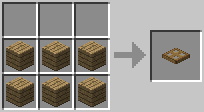
Depending on what type of wood you use, the final Minecraft trapdoor can have different looks. So, using 6x planks of dark oak results in dark oak trapdoors. There are 11 types of wooden trapdoors Minecraft provides you with. These wood types (and matching trapdoors) include:
- acacia trapdoor
- bamboo trapdoor
- birch trapdoor
- cherry trapdoor
- crimson trapdoor
- dark oak trapdoor
- jungle trapdoor
- mangrove trapdoor
- oak trapdoor
- pale oak trapdoor
- spruce trapdoor
- warped trapdoor
All of these Minecraft trapdoors function similarly though, so the only thing you have to look out for is their looks and how they fit within your buildings.
Copper Minecraft Trapdoor
Copper trapdoors have been in the game since Minecraft 1.21, and they’re special because as any other copper item or block, they oxidize over time. In Java 1.21.9, the copper trapdoor recipe changed to 4x copper ingots and now yields 1x copper trapdoor. Copper variants are handled via mechanics, not ‘different crafting ingredients’:
- wax with honeycomb to stop oxidation
- scrape with an axe to remove wax or roll oxidation back one stage
- lightning fully de-oxidizes non-waxed copper trapdoors (and can affect nearby ones)
So, knowing the copper mechanics and especially after the ‘The Copper Age’ gamedrop, here is your way to Minecraft copper trapdoors with a slightly adjusted Minecraft trapdoor recipe:
4x copper ingots = 1x copper trapdoor
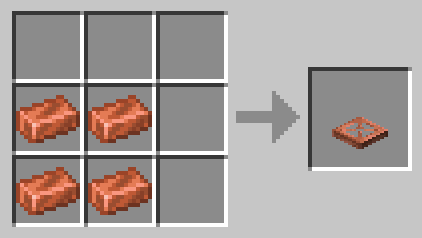
You can also use copper blocks. The main difference here is the state of the copper. In the game, copper can have one of 4 properties that determine its exact appearance:
- natural
- exposed
- weathered
- oxidized
Additionally, copper can be waxed using beeswax, halting the advancement of oxidation. All 4 blocks of copper you use for the trapdoor must have the same properties and the Minecraft trapdoor that they produce will have the same properties as well.
Iron Minecraft Trapdoor
An iron trapdoor is the ‘nope’ option: unlike wooden and copper trapdoors, it can only be opened with redstone power. It’s also harder than wooden trapdoors (so it’s a better choice for secure builds) and it requires a pickaxe to reliably drop as an item when mined. Finally, an iron Minecraft trapdoor is crafted this way:
4x iron ingot = 1x iron trapdoor
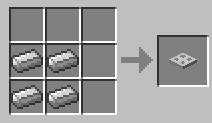
Generally, Minecraft trapdoors are easy to craft, requiring only a few materials. While copper can be difficult to find in certain biomes, wood and iron are very common.
Breaking a Minecraft Trapdoor
Breaking a Minecraft trapdoor is straightforward, but the tool you use matters if you want the item back:
- wooden trapdoor minecraft variants – mined with any tool; axe is the fastest; drop themselves
- iron trapdoor – needs a pickaxe to drop as an item
- copper trapdoor – needs a stone pickaxe (or better) to drop as an item
An extra mechanic that trips people up is that a trapdoor can stay in place even if the block it’s attached to is removed or destroyed. So, it won’t always ‘pop off’ like some other attachment blocks.
How to Use Trapdoors in Minecraft
There are some things all Minecraft trapdoors have in common. Those are:
- 1×1 block in size, can be placed on the sides, tops or bottoms of other blocks
- can be in either an open or closed state
- can be operated using redstone signals
- act as solid blocks when closed and as non-solid blocks when opened
- drop themselves as items when broken
- block water and lava when closed
- lanterns, torches and flower pots can be attached to closed trapdoors
- mobs pathfind as if trapdoors are closed, so they happily walk over an open one and fall
- they can create a breathable pocket underwater if they’re not waterlogged
- closing a trapdoor one block above the ground while standing under it forces crawling, which is great for secret 1-block-high tunnels
Meanwhile, other properties are type specific. For iron Minecraft trapdoors specifically, that means:
- can only be opened or closed using a redstone signal
- have higher durability compared to wooden trapdoors
- have a uniform metallic texture
- are non-flammable and can’t be set on fire
Keeping these properties in mind, you can construct several useful redstone circuits utilizing the type of Minecraft trapdoor you need. Some players have also searched for a so-called ‘Minecraft redstone trapdoor’, though they are most likely confusing the iron trapdoor for it, as it is the only one that has to be opened using a redstone signal. Still, it is not the only one that can be opened by redstone.
Some Minecraft Trapdoor Use Cases
One of the most important interactions Minecraft trapdoors have is probably with mobs. However, that is definitely not all there is! In the following section, we have compiled a few basic constructs that use one or more Minecraft trapdoors.
A) Compact Entrances and Exits:
A Minecraft trapdoor makes a clean floor hatch for ladders, basements, mines or ‘I swear this isn’t a secret base’ entrances. You can even combine trapdoors with ladders for specific climbing setups (single trapdoors above ladders can be climbable in the right configuration). For security, an iron trapdoor tied to a button/lever is the simplest ‘keep mobs out’ upgrade.
Example: A hideout that conceals you from other people on an SMP server can make the difference between survival and a digital death.
B) Aesthetic Enhancements:
Trapdoors are basically ‘build seasoning’:
- shutters (oak trapdoor / dark oak trapdoor look great on windows)
- table tops, vents, wall panels, ceiling details
- contrasting accents (an acacia trapdoor pops on dark stone builds)
Copper trapdoors add an ‘industrial’ look that naturally changes over time, and waxing lets you keep a specific color stage for long-term builds.
Example: A western-style saloon entrance to your house can be the perfect fit for a themed roleplay.
C) Fluid Control:
Because Minecraft trapdoors block flowing water and lava, they’re handy for quick stream control, safe lava edges and compact water builds. The underwater air-pocket trick is also a lifesaver in early-game ocean work: place trapdoors so you get breathable spaces without needing potions, as long as the trapdoor isn’t waterlogged.
Example: Using a daylight sensor and some redstone dust, you can ensure that your crops are watered while the sun shines.
D) Mob Control:
This is one of the best Minecraft trapdoor uses: pathfinding mobs treat trapdoors as closed, so open trapdoors can act like invisible holes in a floor. That’s why they show up in many mob grinders and simple ‘walk here, fall there’ traps. Trapdoors can also control movement of boats/items/minecarts in certain setups, acting like a switchable ‘stop/go’ barrier.
Example: You can keep some spiders or skeletons in an enclosure, building a trap that kills them regularly while keeping the loot secure. This can ensure a steady supply of bone meal or spider eyes.
E) Redstone Contraptions:
Every experienced Minecraft player wants to know about items and blocks you can combine with the game’s ‘electricity’ aka redstone. So, Minecraft trapdoors are redstone mechanisms that can be powered in multiple common ways (torches, dust configured toward the trapdoor, powered blocks, buttons and more). Specific use cases include but are not limited to:
- hidden entrances (trapdoor floor + piston staircase vibes)
- redstone-controlled hatches in farms
- ‘security lids’ on drop shafts (iron trapdoor = redstone-only access)
Example: Use an iron trapdoor as a secure floor hatch over a ladder shaft. Hide a button/lever in your wall (or behind a painting) and run a redstone line to the trapdoor. When powered, the iron trapdoor opens; when unpowered, it closes again, giving you a simple ‘redstone-only access’ entrance that mobs (and most players) can’t casually open by hand.
FAQ
For the wooden Minecraft trapdoor recipe, place 6x matching planks in two full rows (3×2) to get 2x trapdoors. For 1x iron trapdoor, use 4x iron ingots in a 2×2 pattern. For 1x copper trapdoor, use 4x copper ingots in a 2×2 pattern.
Use the trapdoor item while pointing at the block face you want it attached to. Where you click (top half vs bottom half) decides whether the trapdoor occupies the top or bottom part of the block space and whether it opens up or down.
Wooden and copper trapdoors can be opened by hand and also controlled by redstone. Iron trapdoors are redstone-only. From there, you can use them for hatches, decoration, fluid control, crawling entrances, mob traps and more.
Yes, a Minecraft trapdoor blocks flowing water and lava (with special behavior if the trapdoor is waterlogged).
Because mobs consider all trapdoors ‘closed’ for pathfinding, they’ll walk onto an open trapdoor and fall.
Unhinged Finale: The Minecraft Trapdoor Wrap-Up
Trapdoors are basically the Swiss Army hinge of Minecraft: cheap to craft, easy to automate and weirdly powerful once you start combining them with fluids, pathfinding and redstone. While the wide range of creativity isn’t unusual for the game as a whole, the Minecraft trapdoor exemplifies the incredible range of aesthetics and use cases a simple door can provide. Throughout its myriad of visual designs and different properties, the Minecraft trapdoor remains one of the simplest yet useful blocks in the game. If you now want to open the trapdoor to a new world, you can do so on a Minecraft server from GPORTAL. Construct your own reality and use minimal resources to do so!


